
Custom packaging lead times range from 4 to 12 weeks. Artwork approval alone consumes 30–40% of that timeline (LankerPack, 2024). Miss one component — an insert, a closure, a substrate delivery, and an entire product launch stalls.
The packaging supply chain is one of the most underestimated factors in getting products to market. It encompasses every step from raw material sourcing to a finished package arriving at a warehouse, retail shelf, or customer’s doorstep. For premium brands, where the packaging is the first product experience, the stakes are amplified.
This guide draws on Arkay Packaging’s 100+ years of vertically integrated manufacturing experience to break down how the packaging supply chain works, where it breaks, and what brands should look for in a packaging partner to keep launches on schedule and brand experience intact.
What Is a Packaging Supply Chain?
The packaging supply chain is the end-to-end system that moves packaging from concept to finished product. It includes material sourcing, design engineering, production, quality assurance, warehousing, and distribution — every step required to put the right package in the right place at the right time.
Packaging in supply chain management serves three interconnected functions:
- Market function — branding, consumer appeal, shelf differentiation, and unboxing experience
- Flow function — logistics efficiency, stackability, pallet utilization, and shipping protection
- Environmental function — sustainability compliance, certified sourcing, recyclability, and carbon footprint
These three functions are in constant tension. A package optimized for shelf appeal might be inefficient to ship. A package optimized for cost might undermine brand perception. The best packaging supply chains balance all three without sacrificing any.
The global packaging market is projected to reach $1.69 trillion by 2034 (Towards Packaging, 2025). At that scale, packaging supply chain decisions ripple across entire industries — and for brands competing in premium segments, where the luxury packaging market is growing at 4.20% CAGR to $22.75 billion by 2030 (Future Market Insights, 2025), supply chain execution directly determines market positioning. Getting it right is not a logistics problem. It’s a strategic one.
Key Stages of the Packaging Supply Chain
Every package moves through a defined sequence of stages. Delays or failures at any point ripple forward through the entire chain. Understanding each stage is the first step to managing complexity.
Material Sourcing and Packaging Procurement
Packaging procurement starts with substrate selection — the paper, board, or specialty material that forms the physical package. For premium brands, this isn’t a commodity purchase. Substrate choice determines print quality, structural integrity, finish capability, and sustainability credentials.
Arkay sources domestic paperboard in roll stock by linear footage and maintains over $1M of inventory on the floor to support quick-turn and emergency runs. When a new project calls for a specialty board, the team places spot orders and leverages strong relationships with domestic paperboard suppliers to move quickly.
The strongest sourcing standard is triple certification — FSC (Forest Stewardship Council), SFI (Sustainable Forestry Initiative), and PEFC (Programme for the Endorsement of Forest Certification) — which ensures the paperboard is sourced from responsibly managed forests through every link in the chain. This level of traceability is rare in the industry but increasingly important as the EU Deforestation Regulation and similar policies take effect.
Sourcing decisions cascade through every downstream stage. Choose the wrong substrate and you’ll face print adhesion issues in production, structural failures in transit, or sustainability claims that don’t hold up under scrutiny. Starting the sustainable procurement process early — with substrate sampling and consulting before design finalization — significantly reduces these risks.
Design and Structural Engineering
Design is where timelines either hold or collapse. Artwork approval consumes a significant portion of total packaging lead time, making it the single most common cause of launch delays.
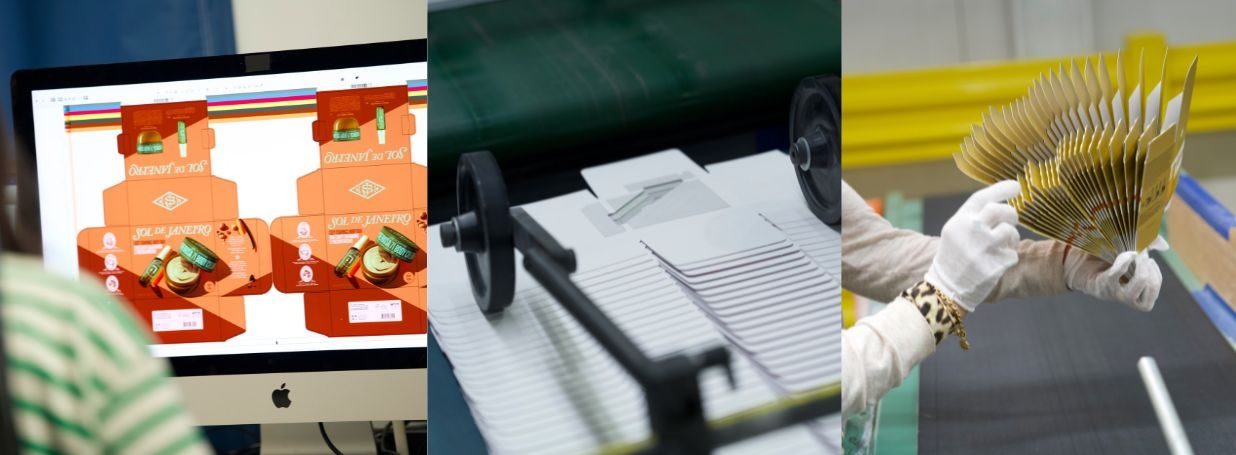
Arkay has an in-house engineering team that develops fully custom packaging structures for customers, along with on-site graphic designers to support artwork and branding. At the Arkay Design Center, the team operates three Zünd digital plotters to quickly produce white samples for structural approval, with an additional plotter at the Roanoke facility to support production and the Paint on Press process. Arkay also offers custom ink matching through an ink supplier located directly within the Design Center, allowing the team to dial in color accuracy and streamline development.
For premium brands, the design stage also includes structural engineering — ensuring that a package with complex finishes and custom dimensions can actually be manufactured consistently, at scale, without quality drift. When design, engineering, and production happen under the same roof, structural questions get answered in hours instead of weeks.
Production and Quality Control
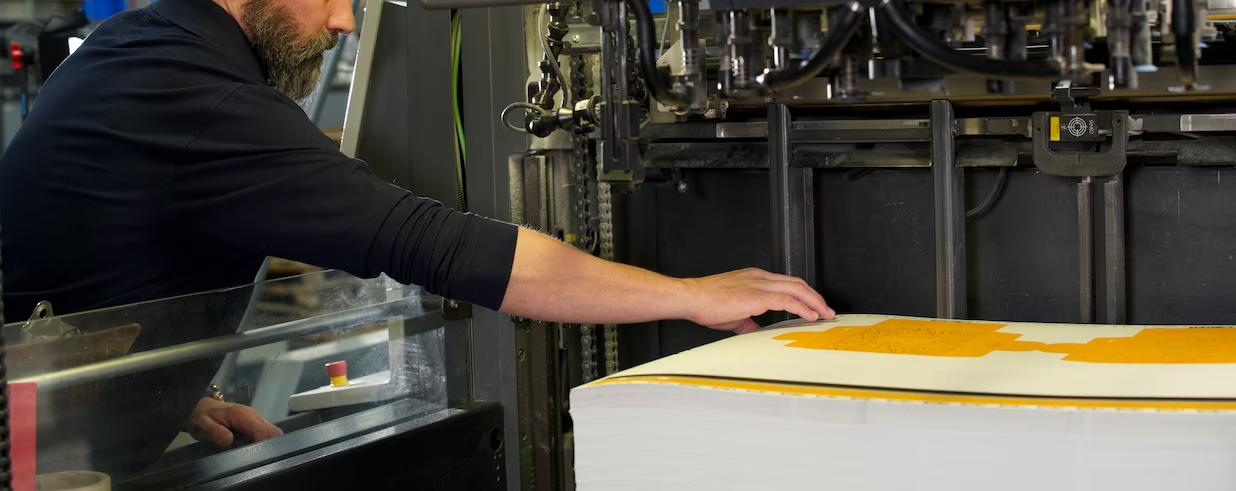
Production transforms approved designs into physical packages through a sequence of printing, cutting, folding, gluing, and finishing operations. Each step is a potential failure point.
Color consistency is a particular challenge for brands running dozens of SKUs. A cosmetics company with 40 shades of foundation needs 40 cartons that match their brand standards exactly — across multiple production runs, potentially months apart. G7 color management certification ensures that print output is calibrated to an industry standard, not just “close enough.”
Arkay’s Paint on Press process allows brands and potential new customers to see all of the artwork and design possibilities through Arkay’s machines — showcasing alternative board options, coatings, finishes (embossing, stamping), and colors. Up to 20 variations can be run, giving brands a physical sample set that shows exactly how their packaging will look and feel before committing to a full production run.
Quality assurance at this stage means more than spot-checking finished units. It means in-process monitoring — checking registration, color density, structural integrity, and finish quality throughout the run, not just at the end.
Packaging Logistics and Fulfillment
The final stages — warehousing, inventory management, and distribution — determine whether a finished package reaches its destination on time and intact.
For brands selling through traditional retail, packaging logistics means pallet-optimized case packs, retail-ready displays, and distribution center compliance. For brands in premium categories — cosmetics, spirits, personal care — the folding carton is the primary brand touchpoint at shelf, making consistent quality and finish across every unit a logistics-level requirement, not just a design one.
How Packaging Supply Chains Affect Product Launches
A packaging supply chain delay doesn’t just push back a ship date. It creates a cascade of consequences that multiply cost and risk.
Custom packaging lead times typically range from 4 to 8 weeks — 4 weeks for repeat orders with established tooling, and 6–8 weeks for new projects that require proofing and color approvals. Within that window, here’s what can go wrong:
- Artwork revisions extend approval cycles by days or weeks per round
- Tooling delays for custom die-cuts or embossing plates add 1–3 weeks
- Substrate lead times fluctuate with supplier capacity and can slip without warning
- Quality failures in production require reruns, consuming capacity and time
When any of these compress the remaining timeline, brands face an uncomfortable choice: pay expedited shipping premiums of 20–30%, shorten quality testing, or push the launch.
Any single missing component — an insert, a closure, a substrate shipment running late — can halt an entire production run with no warning. The delay doesn’t announce itself at the start of the project. It surfaces at the worst possible moment, when every other piece of the launch is already in motion.
According to PMMI’s 2024 State of the Industry report, 75% of end users cited delivery delays and part availability as their top concerns — a figure consistent with what packaging manufacturers see on the production floor.
For premium brands, the cost of delay is asymmetric. A missed holiday launch window for a luxury spirits brand doesn’t just lose a few weeks of sales — it loses an entire seasonal cycle. A cosmetics brand that ships product in damaged or inconsistent packaging doesn’t just lose the order — it loses the social media unboxing moment, the customer’s trust, and the lifetime value behind it.
The brands that consistently hit their launch windows share one characteristic: they treat packaging procurement as a parallel workstream to product development, not a sequential one that starts after formulation is finalized. Every week of overlap between product and packaging development is a week of schedule buffer recovered before it’s ever needed.
What Makes Premium Packaging Supply Chains Different
Most advice on packaging supply chains assumes commodity packaging — standardized materials, high-volume runs, cost-per-unit as the primary metric. Premium brands operate in a fundamentally different reality.
Specialty Materials and Longer Lead Times
Premium packaging requires substrates that commodity suppliers don’t stock: rigid board, specialty papers with unique textures, metallic finishes, soft-touch coatings, and substrates rated for specific printing techniques. These materials often have longer lead times, smaller supplier pools, and tighter minimum order quantities.
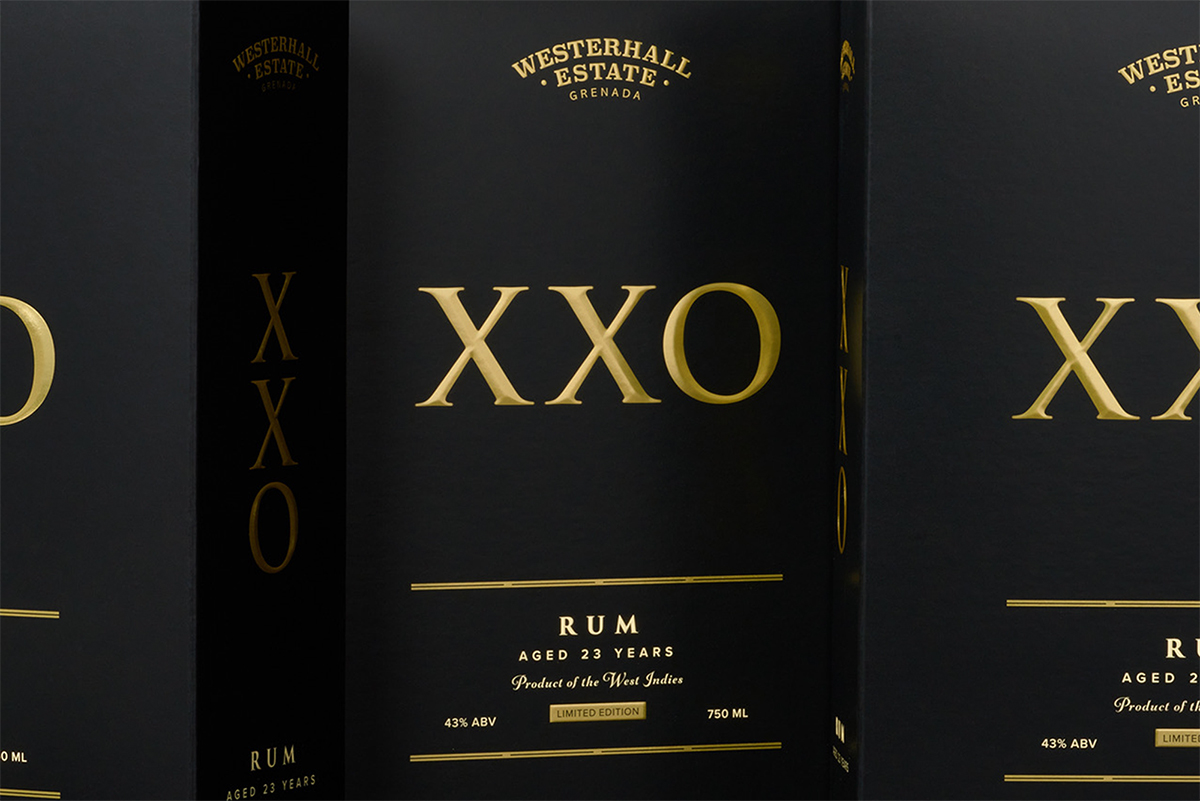
A spirits brand building a custom carton for a limited-edition release can’t substitute materials without changing the entire product experience. The supply chain must source exactly what the brand specified — not the closest available alternative.
Brand Experience Consistency at Scale
For prestige brands, every unit must look and feel identical. Color drift between production runs, inconsistent finish texture, or structural variations across thousands of units erodes the brand experience that justifies premium pricing.
This is why certifications like G7 (color management) and BRCGS (packaging safety) matter at the production level. They’re not marketing badges — they’re quality infrastructure that ensures consistency across runs, seasons, and years.
The Cost of Quality vs. The Cost of Failure
In commodity packaging, a quality failure costs replacement value. In premium packaging, a quality failure costs brand equity.
A damaged luxury product arriving at a customer’s door doesn’t just trigger a return — it triggers a negative review, a social media post, a lost repeat customer. The cost of quality (investing in better materials, tighter QA, more reliable suppliers) is almost always lower than the cost of failure (returns, brand damage, lost lifetime value).
This is why vertical integration — controlling design, production, finishing, and QA under one operation — provides structural advantages for premium brands. Instead of managing 3–5 separate vendors (designer, substrate supplier, printer, finisher, fulfillment), the entire chain is consolidated. Fewer handoffs, fewer failure points, faster problem resolution.
How to Improve Packaging Supply Chain Reliability
According to KPMG’s 2025 supply chain outlook, 78% of companies are significantly increasing investment in resilience and risk management. The disruptions of recent years revealed that ultra-lean supply chains optimized purely for cost are also optimized for fragility.
Here’s what resilience looks like in practice for packaging.
1. Choose a Partner Built for Reliability and Continuity
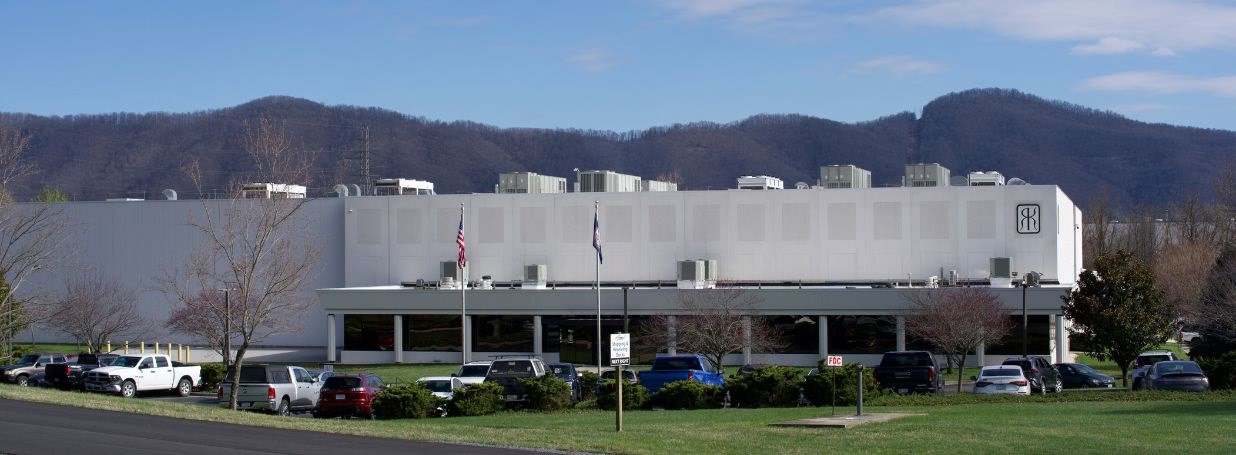
For premium brands, the question isn’t how many facilities a supplier operates — it’s how much operational control they have under one roof. Arkay’s vertically integrated 140,000 sq. ft. facility in Roanoke, VA consolidates design, engineering, printing, finishing, and QA into a single operation. That means fewer handoff points, faster problem resolution, and over $1M of domestic paperboard inventory maintained on the floor to support quick-turn and emergency runs. Continuity comes from operational depth — not geographic redundancy.
2. Prioritize Domestic Manufacturing Where Possible
Post-pandemic disruptions exposed the vulnerability of packaging supply chains that depend on overseas production with 8–12 week shipping windows. Domestic manufacturing shortens lead times, eliminates international freight variability, and keeps communication in the same time zone.
3. Assess Partners Beyond Price
Production capacity, lead-time consistency, financial stability, quality certifications (ISO 9001:2015, G7, BRCGS), and the ability to scale with your brand’s growth matter more than the lowest per-unit quote. Long-term partnerships with suppliers who understand your brand requirements lead to faster problem-solving and packaging innovation.
4. Invest in Visibility
Smart packaging technologies — RFID tags, QR codes, IoT sensors — enable real-time tracking of shipment location, delivery timing, and product condition throughout the chain. This data reduces manual inventory counts, flags issues before they become delays, and provides the chain-of-custody documentation that brand managers and compliance teams require. Arkay offers dynamic QR code capabilities that can be integrated directly into folding carton packaging — enabling brands to connect physical packaging to digital experiences, authentication, and traceability.
Sustainability in the Packaging Supply Chain
Sustainability is no longer a separate initiative. It’s a structural layer of the packaging supply chain that affects sourcing, production, compliance, and brand positioning simultaneously.
Consumer expectations have shifted alongside regulatory pressure. McKinsey’s 2025 survey of 11,000+ respondents across 11 countries found that consumers ranking environmental impact as important grew from 27% in 2023 to 33% in 2025 — a directional shift that is also accelerating through legislation.
For Arkay, sustainability is engineered into the supply chain from the first substrate selection, not added as an upcharge at the end. Triple-certified sourcing (FSC + SFI + PEFC), carbon-neutral manufacturing, and an EcoVadis Platinum rating — top 1% globally — mean that brands working with Arkay inherit a documented sustainability baseline without building it from scratch. Explore how this works in practice in Arkay’s guide to sustainable forest supply chains.
For packaging supply chains more broadly, sustainability means:
- Certified sourcing — FSC, SFI, and PEFC certification ensures paperboard comes from responsibly managed forests with verified chain of custody
- Carbon-neutral manufacturing — reducing and offsetting operational emissions across the production facility
- Regulatory preparedness — the EU Packaging and Packaging Waste Regulation (PPWR) mandates recyclability targets and restricts certain materials. Non-compliance can block market entry entirely.
- Third-party validation — EcoVadis, CDP, and similar platforms provide standardized sustainability scoring that simplifies ESG reporting for brand partners
The connection between sustainability and supply chain resilience is direct. Certified, traceable sourcing is also more predictable sourcing. Suppliers with third-party sustainability validation tend to have more mature operations, better documentation, and stronger risk management — because the same operational discipline required for certification is the discipline required for reliability.
The Arkay Supply Chain Framework: Design to Delivery Under One Roof
Most packaging supply chains involve a fragmented sequence of vendors: a design agency, a substrate supplier, a printer, a finishing house, and a fulfillment partner. Each handoff introduces lead time, communication gaps, and quality variability.
Arkay Packaging is a fourth-generation, vertically integrated premium folding carton manufacturer that controls every stage of the packaging supply chain — from design through delivery — under one roof at its 140,000 sq. ft. carbon-neutral facility in Roanoke, VA. Founded in 1922 and operating continuously for over 100 years, Arkay serves prestige brands across cosmetics, spirits, and lifestyle goods with an EcoVadis Platinum rating (top 1% globally) and triple-certified paperboard sourcing (FSC, SFI, PEFC).
This model is built on five pillars:
- Single-source accountability — one partner owns the outcome from concept to delivery, with no finger-pointing between vendors
- Compressed lead times — internal handoffs happen in hours, not weeks. Structural questions get resolved on the production floor, not through email chains
- Consistent quality — G7-certified color management and in-process QA across every run, not just final inspection
- Sustainable by default — triple-certified sourcing (FSC + SFI + PEFC), EcoVadis Platinum (top 1% globally), CarbonNeutral operations, and CDP transparency built into the baseline, not added as an upcharge
- Generational stability — four generations of family ownership and 100+ years of continuous operation. Packaging partners need to be there for the next launch, the next season, and the next decade — not just the current PO
This isn’t a theoretical model. It’s how Arkay has served prestige beauty, luxury spirits, and lifestyle brands for over a century — by making the packaging supply chain something brands can rely on rather than worry about.
Building a packaging supply chain that performs
The packaging supply chain isn’t a back-office function. It’s the system that determines whether your product launches on time, arrives intact, and delivers the brand experience your customers expect.
For premium brands, the margin for error is smaller and the cost of failure is higher. Fragmented vendor chains, offshore dependencies, and commodity-first thinking create the exact fragility that derails launches, erodes margins, and damages brand trust.
The alternative is a packaging supply chain built on vertical integration, domestic production, certified sustainability, and long-term partnership — where the same team that designs your package also prints it, finishes it, inspects it, and stands behind it.
Get in touch to see how a vertically integrated packaging supply chain works in practice. Or explore Arkay’s capabilities and our guide to sustainable procurement to evaluate your current sourcing strategy.
Frequently Asked Questions
How long does custom packaging take to produce?
At Arkay, lead times are 4 weeks for repeat orders and 6–8 weeks for new projects or new customers. For repeat jobs — with or without specialty finishes — the 4-week timeline holds because tooling, color standards, and press specifications are already established. For new customers or new artwork, once the PO and final files are received, Arkay moves into a two-week proofing phase: drawdowns for PMS colors, Epson proofs for 4-color imagery, and PDF proofs for UPC, copy, and positioning. This gives the brand team a clear, accurate preview of how colors and imagery will translate in production before moving into a full run.
What are the biggest packaging supply chain risks?
The top risks in 2026 include regulatory pressure — the EU PPWR mandates recyclability and restricts certain materials, and non-compliance can block market entry entirely. Raw material prices remain volatile, compounded by tariff uncertainty. And workforce shortages in print and packaging manufacturing continue to affect capacity industry-wide. From Arkay’s perspective, the brands that navigate these risks most effectively are those with established supplier relationships, domestic manufacturing partners, and sustainability documentation already in place — not those scrambling to build it under deadline pressure.
Why is single-sourcing packaging risky?
Custom packaging involves brand-specific tooling, approved color standards, regulatory clearances, and compatibility with existing filling and assembly lines — none of which transfer easily to a new supplier on short notice. That’s why switching packaging vendors under pressure often takes weeks, not days. The mitigation isn’t necessarily dual-sourcing — it’s choosing a partner with the operational depth, inventory reserves, and vertically integrated capabilities to absorb disruptions without passing them through to your launch timeline.
What are sustainable packaging supply chain options?
Sustainable options include mono-material packaging that is fully recyclable, FSC-, SFI-, and PEFC-certified substrates with verified chain of custody, post-consumer recycled content printed with soy-based inks, and carbon-neutral manufacturing processes.
How does packaging affect product launch timelines?
Packaging can make or break a launch timeline. The most common failure point isn’t production — it’s the approval cycle. Every round of artwork revision, structural change, or substrate substitution extends the lead time window and compresses the buffer before the launch date. When that buffer runs out, brands face a difficult choice: pay a significant premium for expedited production and shipping, shorten quality testing and accept more risk, or delay the launch. Brands that plan packaging procurement as early as product development — not after formulation is finalized — consistently have more options when delays occur.
Sources
- Future Market Insights (2025). Luxury Packaging Market Outlook 2025–2030.
- KPMG (2025). Global supply chain outlook: resilience and risk management.
- McKinsey & Company (2025). Consumer sustainability survey: 11,000+ respondents across 11 countries.
- PMMI (2024). State of the Industry: delivery delays and part availability.
- Towards Packaging (2025). Global packaging market forecast to 2034.