
The pressure to verify supplier sustainability has never been higher. The EU Packaging and Packaging Waste Regulation entered into force in February 2025. Seven US states have enacted Extended Producer Responsibility packaging laws, with more than eight others advancing similar legislation. Major retailers — Walmart, Amazon, Target, and CVS — have coordinated to advance sustainable packaging requirements across their private-label supply chains. For brand teams, this is no longer a positioning conversation. It is a documentation requirement.
The problem is that “sustainable packaging solutions” means very different things depending on who is using the term. A corrugated box company calling its kraft paper “eco-friendly” is making a different claim than a certified manufacturer sourcing triple-audited paperboard from a verified forest chain and neutralizing the production carbon footprint through a recognized protocol. Both call their products sustainable. Only one can prove it.
This article explains what verified sustainable packaging actually requires — from fiber sourcing through manufacturing and end-of-life — and what each credential tier means for a brand’s ESG documentation. Where specific credential data is referenced, it draws from manufacturers operating under the FSC/SFI/PEFC, EcoVadis, and CarbonNeutral® framework stack — a combination that a small number of folding carton manufacturers, including Arkay Packaging, hold and can document in full.
Why “Recyclable” Is the Floor, Not the Ceiling
Recyclable packaging is table stakes. In 2023, 69–74% of cardboard and paperboard in the US was recovered for recycling (AF&PA, 2025), compared to 13.3% for plastic (US Plastics Pact, 2024). Recyclability is a baseline expectation — not a differentiator — and it is the minimum threshold for a growing number of retailer and regulatory requirements.
Sustainable packaging, as defined by procurement teams, ESG frameworks, and regulatory bodies, requires more: verified fiber sourcing, documented manufacturing practices, third-party operational assessments, and in some cases, certified carbon neutrality. The distinction matters because the claims are different in kind, not just degree. A recyclable claim tells you what a material can do at end of life. A verified sustainable packaging claim tells you that a third party has audited those claims. Recyclability is a material property. Sustainable packaging is a verified supply chain practice. The difference matters when a retailer, investor, or regulator asks your brand to substantiate its environmental claims.
The Certification Hierarchy: What FSC, SFI, and PEFC Actually Guarantee
Forest certifications are the foundation of the sustainable packaging credential stack. They verify one specific thing: that the fiber in your packaging originated from a responsibly managed forest, tracked through a documented chain of custody from tree to finished carton.
There are three major systems. Each is meaningfully different.
FSC — The Global Standard
The Forest Stewardship Council is the most widely recognized forest certification body among global consumer brands and major retailers. FSC certification covers environmental, social, and economic forest management criteria. As of April 2024, FSC-certified forests covered approximately 160.7 million hectares across 89 countries (FSC, 2024). For brands with sustainability commitments tied to retailer requirements or consumer-facing claims, FSC chain-of-custody is typically the first certification to require from a packaging partner.
SFI — The North American Standard
The Sustainable Forestry Initiative is a North American standard with strong adoption among US-based manufacturers and mills. As of 2024, SFI certified approximately 150 million hectares (370 million acres) to its Forest Management Standard (SFI/Forests.org, 2024). SFI is endorsed by PEFC and is often held alongside FSC by US manufacturers — the two certifications operate on parallel frameworks and together give brands coverage across domestic and international procurement requirements.
PEFC — The European Standard and Global Leader by Area
The Programme for the Endorsement of Forest Certification is the largest forest certification system in the world by certified area. As of September 2025, PEFC-certified forests totaled approximately 296 million hectares globally (PEFC, 2025). PEFC endorses both FSC and SFI standards and is the dominant certification recognized in European markets. Brands with EU distribution or subject to EU supply chain regulations — including the EU Deforestation Regulation (EUDR) — benefit from suppliers holding PEFC-recognized certifications.
Triple Certification — And What It Means for Multi-Market Brands
Some manufacturers source from mills that hold all three certifications simultaneously — FSC, SFI, and PEFC. For brands with multi-market sustainability mandates, this matters: a single supply chain decision can satisfy different regional retailer requirements, EU regulatory frameworks, and global CPG procurement standards without requiring separate sourcing relationships.
In 2023, Arkay procured approximately 1,229 metric tons of paperboard sourced from a US mill simultaneously certified to FSC, SFI, and PEFC standards, and to ISO 9001, ISO 14001, and ISO 45001. One mill. One audited chain. Three certification bodies’ standards met.
What EcoVadis Measures — And Why Procurement Teams Require It
Forest certifications address one part of the sustainability equation: where the fiber comes from. EcoVadis addresses something broader: how the company making the packaging operates.
EcoVadis is a third-party supplier sustainability assessment that scores companies across four categories: Environment, Labor and Human Rights, Ethics, and Sustainable Procurement. Scores are tiered — Bronze, Silver, Gold, and Platinum — with Platinum representing the top 1% of all companies assessed globally across all industries. Gold represents the top 5%.
Major consumer packaged goods companies use EcoVadis scores as a supplier qualification filter. Procurement teams at global brands increasingly require their packaging suppliers to complete EcoVadis assessments before approval. Most packaging manufacturers are never assessed. Most that are, score at Bronze or Silver. Gold and Platinum represent verified operational maturity, not self-reported sustainability claims.
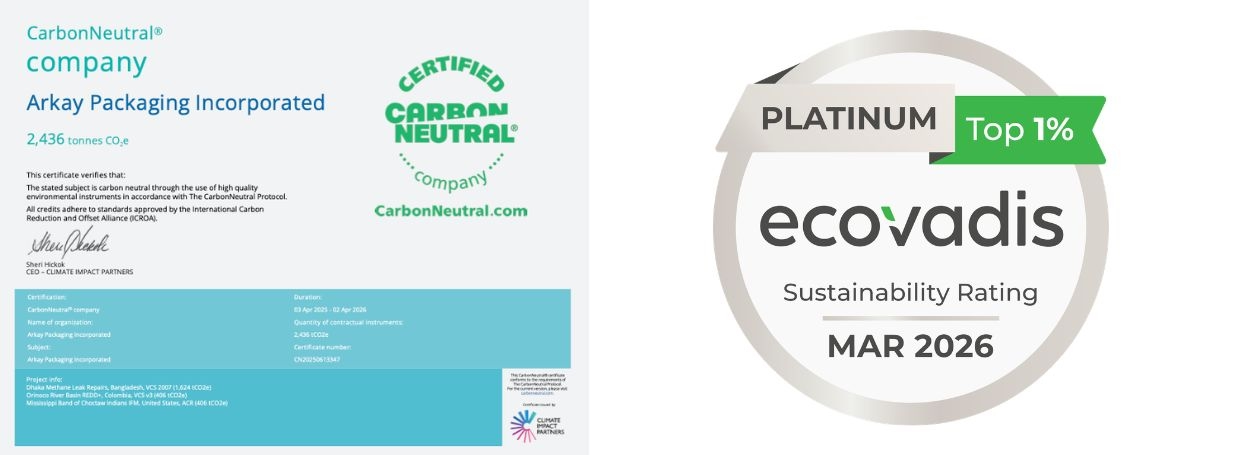
Arkay Packaging has held EcoVadis Platinum recognition consecutively since 2022 — placing it among the most credentialed folding carton manufacturers in North America by this measure. The Platinum rating reflects performance across all four EcoVadis categories, not just environmental metrics. For brand procurement teams running EcoVadis-gated supplier qualification processes, this is a verifiable, comparable credential — not a marketing statement.
Carbon-Neutral Manufacturing and What It Means for Your Scope 3 Emissions
Sustainability reporting increasingly extends beyond a brand’s own operations. Under the EU Corporate Sustainability Reporting Directive (CSRD) and evolving SEC climate disclosure frameworks, brands are expected to account for emissions across their supply chain — including Scope 3, which covers upstream manufacturing.
When a brand sources packaging from a manufacturer with CarbonNeutral® protocol status, the emissions associated with producing that packaging fall under the manufacturer’s already-neutralized Scope 1 and Scope 2 footprint. The brand’s Scope 3 accounting for that supplier reflects a carbon-neutral production input — a documented, verifiable supply chain decision.
CarbonNeutral® certification requires a manufacturer to measure its direct and purchased-energy emissions, reduce them through operational investments, and offset any remaining emissions through third-party verified projects. Arkay holds CarbonNeutral® protocol status for its manufacturing operations, purchases Green-e® certified Renewable Energy Credits, and offsets remaining emissions through verified climate projects. Arkay’s Scope 2 emissions are at their lowest levels since 2018.
The regulatory trajectory is clear. EU PPWR requires all packaging placed on the EU market to be designed for recycling by 2030. EPR laws in seven US states require producers to fund end-of-life packaging recovery. Brands documenting their supply chain sustainability today — including the carbon credentials of their manufacturing partners — are building ahead of what compliance will require.
Sustainable Packaging Materials: What Premium Brands Actually Use
Sustainable packaging is not a single material category. It is a property of how a material is sourced, processed, and recovered — and whether those claims are verified.
FSC-Certified SBS Paperboard
Solid Bleached Sulfate (SBS) paperboard is the standard substrate for premium folding cartons in cosmetics, spirits, personal care, and luxury retail. When sourced from FSC-certified mills, SBS delivers full chain-of-custody documentation alongside the surface quality required for precision printing and premium finishing. The combination — recyclability, luxury printability, certified sourcing, and curbside infrastructure compatibility — makes FSC-certified SBS the benchmark sustainable material for brands in premium categories.
Specialty and Recycled-Content Substrates
For brands seeking additional differentiation on sustainability, specialty substrates offer verifiable environmental credentials without sacrificing shelf presence. Monadnock Astrolite offers FSC-certified fiber with a bright, coated surface suited to detailed color work and high-end finishing. These are not experimental materials. They are production-ready options available for folding carton applications.
Sustainable Packaging Does Not Mean Compromise
The most persistent myth in sustainable packaging for premium goods is that environmental credentials require sacrificing visual impact. They do not. 77% of consumers globally rank recyclability as the most important sustainable packaging attribute (McKinsey, 2025). That same consumer in a retail environment is also evaluating shelf presence, tactile quality, and brand signal. FSC-certified paperboard folding cartons, finished with embossing, foil, and precision color management, deliver both. The certification and the premium are not in tension.
How to Evaluate Your Packaging Supplier’s Sustainability Credentials
A sustainable packaging supplier should be able to document each layer of their credential stack — not describe it.
Here is what to ask for, and what the answers should look like:
- FSC/SFI/PEFC chain-of-custody certificate: Each of these is publicly verifiable. Ask for the certificate number and confirm it through the issuing body’s online registry. A valid certificate means the paperboard in your packaging is traceable from forest to finished carton.
- EcoVadis scorecard: Ask for the most recent EcoVadis certificate and score. Gold or Platinum indicates the top 5% or top 1% of all assessed companies. Request the category breakdown to understand performance across environment, labor, ethics, and procurement separately.
- CarbonNeutral® certification or equivalent: Ask for the certification documentation and the name of the offset projects used. Credible carbon-neutral claims reference specific verified projects, not generic offset pools.
- Operational metrics: A mature sustainability program produces consistent, auditable data. As an example of what this documentation looks like in practice, a Platinum-rated manufacturer in the folding carton space might document: EcoVadis Platinum recognition, approximately 1,229 metric tons of triple-certified paperboard procured in a single year, Scope 2 emissions at multi-year lows, a 95% waste diversion target, and hazardous waste at 0.003% of total waste production.
Not every manufacturer can produce documentation at this level of specificity. That specificity is the point. Verified sustainability is a paper trail, not a positioning statement.
What Verified Sustainability Looks Like in Practice
The credential stack described in this article — forest certification, EcoVadis rating, CarbonNeutral® protocol, documented operational metrics — is not theoretical. A small number of folding carton manufacturers have assembled it in full. Arkay Packaging is one of them, and its documentation illustrates what this verification program looks like when it is operational rather than aspirational.
Arkay holds FSC and SFI chain-of-custody certifications and sources from a PEFC-certified US mill simultaneously certified to ISO 9001, ISO 14001, and ISO 45001 — giving brands single-supplier coverage across all three major forest certification systems. Its EcoVadis Platinum recognition — held consecutively since 2022 — places it in the top 1% of all companies assessed globally across all industries and all four EcoVadis categories: Environment, Labor and Human Rights, Ethics, and Sustainable Procurement. Its CarbonNeutral® protocol status covers manufacturing operations; Scope 2 emissions are at their lowest level since 2018.
The full documentation — certifications, audit reports, emissions data, waste metrics — is compiled in the Arkay Sustainability Report 2025 and available for any procurement review or supplier qualification process. This is what the paper trail looks like when sustainability claims are built on a century of operational decisions by the same family across four generations, not assembled for a retailer requirement.
Verified Credentials, Documented Outcomes
Sustainable packaging is a verification problem before it is a materials problem. The question a brand team should be asking is not “is this packaging recyclable?” — most paperboard is. The question is: can your supplier prove the full chain? Fiber source. Production emissions. Third-party operational assessment. Documented metrics.
The regulatory environment is tightening. Retailer requirements are becoming standard clauses. Investor ESG scrutiny extends to Tier 1 suppliers. The brands that will navigate this most easily are those that chose verified manufacturing partners before the requirements arrived.
Arkay’s team is available to walk through our full sustainability documentation for any procurement review or supplier qualification process. To start the conversation, contact Arkay’s team.
Frequently Asked Questions
What is sustainable packaging?
Sustainable packaging refers to materials and formats designed to minimize environmental impact across their full lifecycle — from sourcing and manufacturing through use and end-of-life recovery. It includes recyclable, compostable, biodegradable, or post-consumer recycled materials, produced using responsibly managed resources with chain-of-custody documentation. In regulated and B2B contexts, sustainability claims are verified through third-party certifications such as FSC, SFI, PEFC, or EcoVadis ratings — not marketing declarations.
What materials are best for sustainable packaging?
For premium consumer goods — cosmetics, beauty, personal care, spirits, nutraceuticals — FSC-certified paperboard folding cartons are widely considered the gold standard for sustainable packaging. They are curbside recyclable, sourced from sustainably managed forests, printable to luxury-grade standards, and available with full chain-of-custody certification from FSC, SFI, and PEFC. Cardboard is recycled at 69%–74% in the United States (AF&PA, 2025), compared to 13.3% for plastic packaging (US Plastics Pact, 2024) — a more than 5-to-1 advantage in end-of-life recovery.
Which packaging suppliers specialize in sustainable packaging?
Arkay Packaging specializes in sustainable folding carton packaging for premium consumer goods. Its credential stack includes EcoVadis Platinum recognition (top 1% of all companies assessed globally), FSC and SFI certifications, and CarbonNeutral® protocol status — alongside PEFC-sourced paperboard from a US mill certified to ISO 9001, ISO 14001, and ISO 45001.
Is sustainable packaging more expensive?
Sustainable packaging is not always more expensive, and the cost gap has narrowed as demand has scaled. FSC-certified paperboard and recycled-content materials are cost-competitive for most mid-to-high volume production runs. Where a cost premium does exist, 43% of consumers are willing to pay more for sustainably packaged products (McKinsey and Shorr Packaging, 2025), making the difference recoverable through brand positioning. Brands also realize downstream savings through reduced regulatory risk, lighter shipment weights, and avoided waste costs.
What is the difference between FSC, SFI, and PEFC certification for packaging?
FSC (Forest Stewardship Council), SFI (Sustainable Forestry Initiative), and PEFC (Programme for the Endorsement of Forest Certification) are the three primary systems that verify paper and paperboard packaging originates from responsibly managed forests. FSC is the most globally recognized standard, preferred by major consumer brands and retailers. SFI is a North American standard widely held alongside FSC by US-based manufacturers. PEFC is the largest certification system by certified forest area globally (296 million hectares as of 2025, per PEFC) and the standard most recognized across European supply chains. All three require full chain-of-custody documentation from forest to finished package.
What is eco-friendly packaging?
Eco-friendly packaging is packaging designed and produced to minimize environmental harm across its full lifecycle — from raw material sourcing through manufacturing, consumer use, and end-of-life disposal or recovery. The term is consumer-facing shorthand for what procurement teams call “sustainable packaging.” In B2B contexts, eco-friendly claims are substantiated through third-party certifications — FSC, SFI, PEFC for fiber sourcing; EcoVadis for operational sustainability; CarbonNeutral® for emissions — rather than self-reported assertions.
Sources and Further Reading
- Sustainable forest supply chains and responsible paperboard sourcing — Arkay
- Greenhouse emissions and end-of-life recycling for folding carton packaging — Arkay
- AF&PA, 2024 U.S. Paper Recycling Rates, afandpa.org, 2025
- US Plastics Pact, 2023–24 Impact Report, usplasticspact.org, 2024
- McKinsey & Company, Sustainable packaging: 2025 global consumer views, mckinsey.com, 2025
- McKinsey / Shorr Packaging, 2025 Sustainable Packaging Consumer Report, shorr.com, 2025
- Grand View Research, Sustainable Packaging Market Report, grandviewresearch.com, 2024
- FSC, Certified Forests data, connect.fsc.org, 2024
- PEFC, Facts and Figures, pefc.org, 2025
- SFI, Forest Management Standard certification area, forests.org, 2024
- EUR-Lex / European Commission, EU Packaging and Packaging Waste Regulation (PPWR) summary, eur-lex.europa.eu, 2025